

How do you plan a commercial Christmas display for a city, shopping center, or public space? Planning a commercial Christmas display for a public space requires starting six to nine months in advance to manage logistics, permits, and commercial-grade product orders.
Planning a commercial Christmas display for your public space can feel overwhelming, especially when the project has just landed on your desk.
You may be responsible for decorating an entire downtown district, turning a public park into a Christmas destination, or creating an experience that brings more shoppers to a commercial property. Whatever the setting, you are making decisions about design, budget, installation, electrical access, public safety, and storage. You are not simply choosing Christmas decorations. You are helping shape the experience residents, visitors, employees, and local families will associate with Christmas in your community. For many of them, this display may become the backdrop for an annual tradition, a cherished family photograph, or a memory of a night spent with loved ones. And all of these decisions are being made months before your displays even go on.
The good news is that you do not have to make every decision at once. The empty plaza, quiet park, or undecorated street in front of you today can become a place that feels completely different when the Christmas season arrives. The transformation begins with a clear path.
A memorable public Christmas display begins with a series of practical choices. First, you need to set your goals. Decide if you want your display to boost retail foot traffic, build civic pride, or create a photo destination. Once you understand your space, audience, and what you want your display to accomplish, it becomes much easier to select the right commercial Christmas decorations for your display.
Creative Displays has helped organizations plan Christmas displays and lighting since 1959. For more than 65 years, we have guided our customers through the process, from concept to installation, we are there to assist our customers from their first call in to us. With our extensive time in business, we have picked up on the best ways to plan a commercial Christmas display for a public space. Here is how we recommend approaching the process.

Start with Your Space, Not a Product Catalog
The most important first step when planning your commercial Christmas display is to measure your property or space before purchasing any decorations. One of the most common mistakes people make is buying their display before evaluating the property, and it ends up being too large or small for the area.
A 30-foot Christmas tree may look incredible in the right plaza, but it will not solve every design challenge. A walk-through ornament may attract plenty of attention, but it still needs a location that supports visitor movement and photography. Even a coordinated collection of pole mount Christmas decorations can lose its impact if the spacing, scale, and surrounding environment are not considered. You need to begin by measuring your layout and mapping visitor flow.
- Choose a layout that works best for your space- Use a hub-and-spoke layout for city squares and malls, or a linear/loop path for parks and high streets.
- Map the customer journey- Treat your space like a set design or a journey. Decide how you want people to move through and interact with your space.
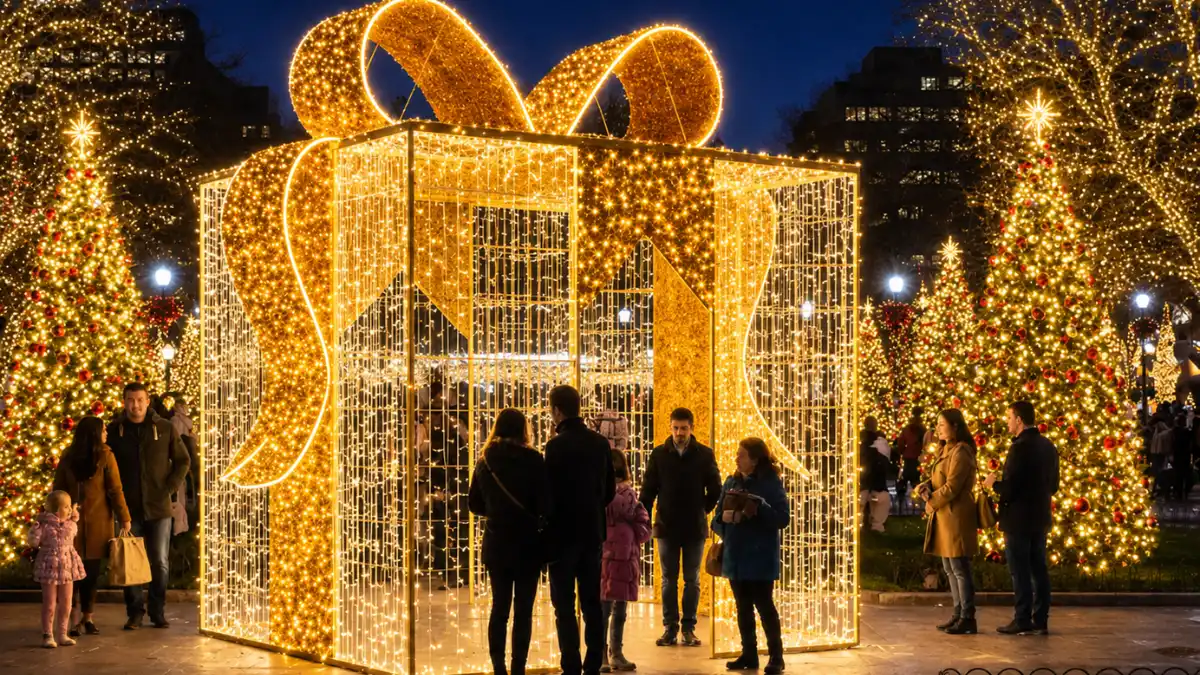
- Anchor your display with a centerpiece- Build your display around a major focal point, such as a giant commercial Christmas tree or large, immersive walk-through displays.
- Design designated photo zones- One of the main reasons people visit commercial Christmas displays is to take Instagram worthy photos. Our team at Creative Displays suggests creating dedicated spots for photos. Make sure that you plan these areas with enough depth for cameras without blocking the main walkways.
Begin by looking at the entire property, not just measuring, but fully examining the space. Ask yourself, from which direction will most people see the display? Where do people naturally gather? Will visitors experience your displays on foot or from a vehicle? Are there any trees, buildings, light poles, or architectural features you want to emphasize? Are there areas that must remain clear for traffic, snow removal, or emergency access?
These are all practical questions, but their answers shape the way people experience and remember your display. The same street residents travel every day can feel new under Christmas lights. A familiar town square can become the place where the community gathers to celebrate the season. Even an overlooked corner of a shopping center can become a setting people deliberately stop to photograph.
All of these questions are important factors in the planning and decision making process.
Start Early to Determine Your Goals and Budget
Municipalities, businesses, and other commercial properties need to begin planning in spring or early summer to secure product availability and installation crews. Starting early in the year also gives them optimal time to set the goals and the budget of their display.
Allocating a dedicated budget early in the year, so you can receive your displays in time, is a crucial part of the planning process. Your city, business, or other commercial property needs to account for purchasing commercial-grade materials, paying a team for installation (if needed), maintenance, and off-season storage.
The type of property that you’re decorating will also influence which decorations should receive the largest share of the budget.
| Type of Property | Common Display Priorities | What to Consider First |
|---|---|---|
| Downtown District | Pole mount decorations and a coordinated streetscape | Maintaining a cohesive appearance across multiple blocks |
| Town Square or Plaza | A large, captivating center piece; a community gathering point | Creating a showstopping visual anchor |
| Public Park | Walk-through displays and large focal pieces | Visitor movement, photo worthy spaces, event routes |
| Shopping Center | Photo opportunities, decorated entrances | Foot traffic, dwell times, and visibility from parking areas |
| Civic Building | Continuity throughout the entire building | Dwell time, foot traffic, ease of storage and installation |
This initial assessment of any commercial space gives your display a foundation. Instead of purchasing individual items because they look festive, you can choose pieces that fit your display’s theme, fit your budget, and match the needs of your space.
Decide What You Want Your Display to Accomplish
The first thing anyone planning a commercial Christmas display needs to do is define what a successful display looks like. Success may be measured in foot traffic, event attendance, or retail activity, but it can also begin with a simpler question: What do people want to feel when they arrive? Welcomed? Excited? Nostalgic? Proud of their community? That emotional goal should influence the colors, scale, lighting, and decorations you select.
A municipality may want its display to encourage residents to spend more time downtown. A parks department may be planning a ticketed Christmas light experience. A shopping center may want photo opportunities that motivate customers to share their visit on social media. Another organization may simply want to create a welcoming Christmas atmosphere around an important public building. Your goal affects the way the display should be designed.
For example, if your priority is visibility from the road, you may need large silhouettes, pole mount Christmas decorations, or a tall commercial Christmas tree that can be seen from a distance. If you want visitors to walk through the space, the plan may include illuminated arches, ground displays, and photo opportunities positioned along a clear route.
One tip our team suggests to all of our commercial buyers is to write down the primary purpose of your display before you begin choosing your products. This will help you keep your goals front and center during the purchasing period and ensure that every decoration helps you reach your defined objective. When the purpose is clear, the display becomes more than just a group of products. Every piece contributes to the experience you want people to have.
Build a Cohesive Look Instead of Collecting Individual Pieces
A strong commercial Christmas display feels uniform and intentional from one end of the property to the other. Every piece is intentionally purchased and positioned to draw the attention of visitors. That does not mean that every decoration must be identical. It means that each piece should feel like it belongs to the same place and the same Christmas story. The goal is to draw visitors deeper into the experience without visual elements competing for their attention.
Pole mount Christmas decorations can establish a repeated pattern along a street or throughout a parking area. A commercial Christmas tree can serve as the main focal point. Wreaths, garland, and bows can carry the same colors onto entrances, railings, columns, and building facades. Ground-mounted or walk-through displays can add dimension and give visitors a reason to explore.
Repetition is one of the simplest ways to create cohesion. Repeating a color, shape, lighting style, or greenery treatment helps connect areas that may otherwise feel unrelated.
For example, a downtown district might use matching pole decorations along Main Street, garland and bows around storefronts, and a larger version of the same motif in the town square. Each area can have its own purpose while still contributing to one recognizable Christmas theme.
The Creative Displays team worked with Benton Harbor to create a cohesive streetscape across their city district. Our designers partnered with them to design a streetscape of matching garland and bows that decorated an entire sector of their city. They wanted to create a display that was uniform and eye-catching, which resulted in an increase in foot traffic and dwell time. As visitors move from one block to the next, the repeated details created a sense of continuity throughout their community.
The most effective theme is not necessarily the most complicated one. It is the one that can be applied consistently throughout your city park, shopping center, or public property.
Choose a Focal Point
Every memorable commercial holiday display has a visual anchor.
The focal point is often where the biggest moments of the season take place. It is where the countdown ends during a Christmas tree lighting ceremony, where groups of loved ones stop and pose for photos, and where visitors agree to meet before exploring the rest of the display. It is the piece people see first, and the image that can come to represent Christmas in that location.
Commercial Christmas trees are a popular centerpiece because they immediately establish the scale and purpose of the display. However, an illuminated arch, oversized ornament, dimensional display, or custom-built feature may also fill that role.
When choosing a focal point, consider:
- The size of the surrounding area
- The distance from which the piece will be viewed
- Nearby buildings, trees, and permanent structures
- Expected crowd size
- Installation access
- Electrical access
- Photo and event opportunities
- Off-season storage requirements
The centerpiece should be visually strong enough to hold the space without making surrounding elements feel disconnected.
The City of Columbus selected a 22’ Panel Christmas Tree for its municipal display. Positioned in the downtown district, the tree created a prominent visual centerpiece within the larger Christmas display.
Pay Close Attention to Scale & Sightlines
When planning your public Christmas display, you need to consider that commercial space requires a different sense of scale than residential properties.
A decoration may look grand and substantial in a showroom or product photograph, but may not appear to be as magnificent when installed in a large plaza or public park. Distance, surrounding architecture, and crowds all affect how the display is perceived. This is where first-time planners often undersize their displays. An 18’ Walkthrough Ornament might look ginormous and awe-inspiring in a warehouse, but may be a bit lackluster against several skyscrapers.
Here are some recommended rules of thumb for selecting tree height based on viewing distance or surrounding structures:
- The bigger the space, the bigger the size of your tree should be. If your tree is going to be in a large open space, you’ll need a large tree to fill that space.
- If your commercial Christmas tree is going to be surrounded by tall buildings or architectural pieces, you want a taller tree so it doesn’t look too small against in its environment.

Plan for People, Photos & Events
A commercial Christmas display does more than just fill a space. At its best, it gives people a reason to step away from their routines and spend time with their community. It can turn a trip downtown, an evening at the park, or a shopping day into a fond part of someone’s Christmas season. That experience does not happen by accident. It is shaped through planning how people will enter, move through, photograph, and remember the space.
If your display will be part of a public event, think through the visitor experience from arrival to departure. The layout should naturally lead people toward the main attractions without creating unnecessary congestion.
Place interactive and photo-ready pieces where visitors can safely stop without blocking the primary walkway. If a 34’ Panel Christmas Tree will be used for a lighting ceremony, make sure the surrounding area can accommodate the expected crowd, staging, and event equipment.
You also need to consider how your displays will look in photographs. Visible power cords, temporary barriers, or poorly positioned signage can distract from an otherwise impressive installation. Planning camera angles in advance can help your team identify cleaner backgrounds and more effective display locations.
A well-planned photo opportunity may also extend the impact of the display beyond the physical property. When visitors share pictures, the display can help introduce the destination to a much larger audience. Long after the decorations have been taken down, those photographs remain. Planning a strong, picturesque location gives visitors a way to preserve the experience while giving the city, park, or property a recognizable visual identity during the Christmas season.
Address the Practical Details Early
The creative concept of a commercial Christmas display is important, but it must work within the realities of your property. Visitors may never notice the planning behind the display, and that is the point. When power, mounting, traffic flow, and installation access have been addressed properly, people can focus on the lights and the experience instead of the infrastructure supporting them.
Plan Power Access
It’s important to map out weather-protected electrical outlets and calculate total amperage to avoid unsafe extension cords across walkways. Your team needs to understand where electricity is available, how decorations will be distributed across the property, and whether additional electrical work may be required.
Secure Mounting Surfaces
Determine if your displays are going to sit on soil with ground stakes or hardscapes that require specialized ballast weights and brackets. If you need specialized weights or brackets to hold your displays, you need to start planning early in the year to get those purchased or made.
Use Commercial Grade Decorations
Select waterproof, durable, LED-standard decorations (IP65 rated) that withstand heavy winter weather and public contact. Commercial-grade products are designed for demanding seasonal environments and repeated use. That distinction becomes especially important when a city, park, or shopping center intends to reinstall the display year after year.
Automate Controls
Put your display groups on automated schedules or smart timers instead of manual switches. This makes it easier on your team because no one has to go out and manually plug in the lights every night your display is open.
Installation Access
Large commercial Christmas decorations may require lifts, equipment, or multiple installers. Delivery and installation teams need a clear route to the installation area, especially when working around landscaping, curbs, traffic or pedestrian zones.
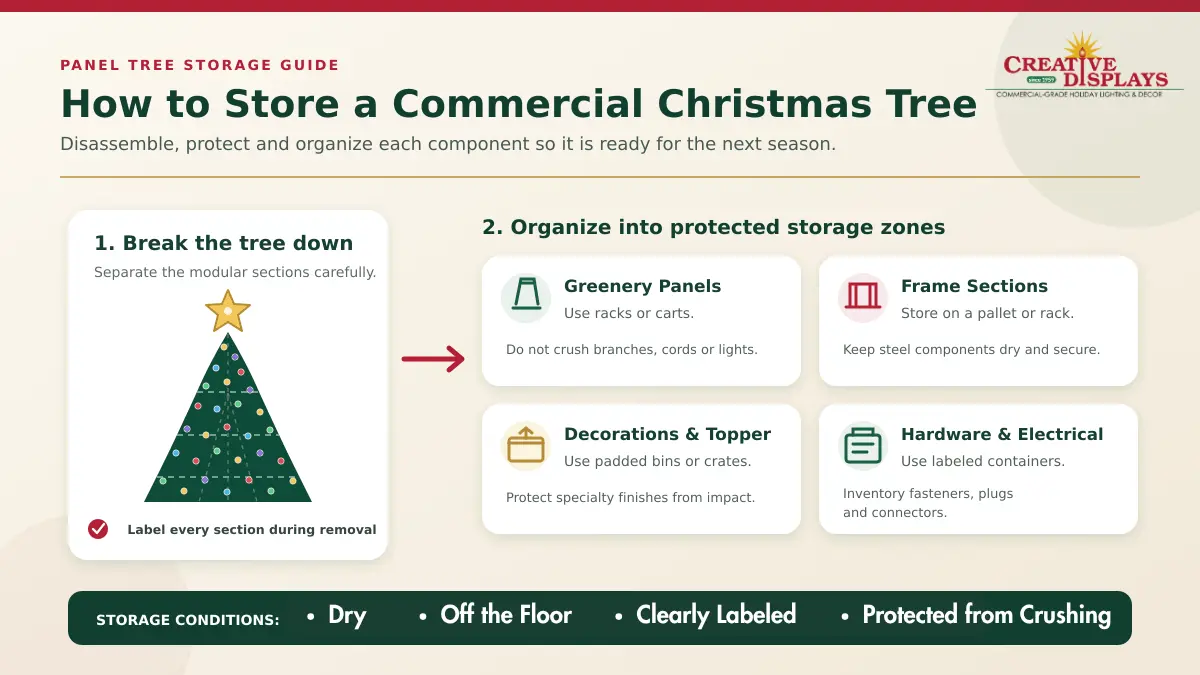
If you are considering a large panel Christmas tree, confirm that equipment can safely reach the site. Panel trees break down into frame sections and individual panels, which helps with transportation and storage, but the upper sections may still require a lift during installation.
Takedown & Storage
Storage should be part of the buying decision, not an issue addressed after the Christmas season.
Determine where the decorations will be stored, how much room is available, and who will be responsible for organizing the inventory. Labeling sections and maintaining installation records can make the following year’s setup easier. Careful takedown and storage protect more than just the physical decorations. They protect the organization’s investment and make it possible to bring the experience back the following Christmas season.
Build Your Commercial Christmas Displays Over Multiple Years
The most successful commercial Christmas displays are not completed in a single season. They grow alongside the communities and properties they serve. A display may begin with one tree, one decorated entrance, or one block of pole mount decorations. Over time, those first pieces can become the foundation of an experience people recognize as part of Christmas in that location.
Many municipalities, shopping centers, light parks, and other public spaces build their displays in phases. First, they invest in pieces that will make the greatest immediate impact and expand their display over the coming years.
A first year plan for a municipality might be investing in a coordinated group of pole mount decorations for their downtown district or a giant Christmas tree for their city park. A shopping center might start their display by purchasing greenery to go around a primary entrance. And other public spaces might first purchase a couple of immersive dimensional displays to encourage people to stop and take photos.
In the following years, each space can expand by adding more photo opportunities, greenery, or decorations that extend your display into another block or section of the property.
The key to building a successful, long-term Christmas display is to plan the concept before making the first purchase. That way, every new addition supports the same theme instead of making the property feel like a collection of unrelated decorations.
Building in phases does not mean settling for an incomplete vision. It means giving that vision room to grow while creating something meaningful from the very first year.
Creative Displays has partnered with Demarest Farms to help them create a successful holiday light display over several years. The team at Demarest started their display years ago by purchasing a few commercial holiday light displays, and has expanded their display every year for nearly a decade. They have reported an increase in foot traffic and revenue every year they expand their display.
Create a Written Plan Before Requesting Pricing
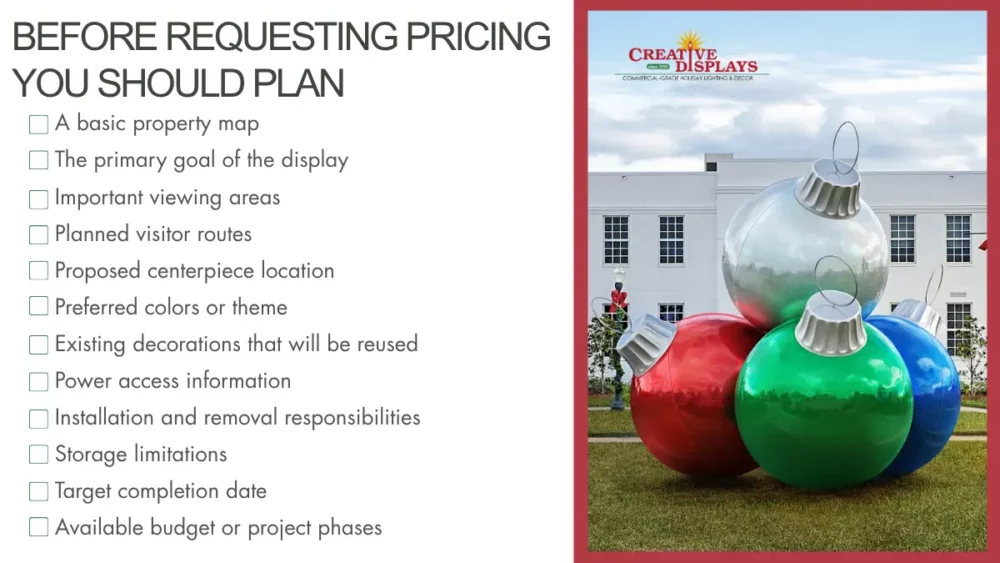
Once you understand the space, goals, theme, focal point, and practical requirements, put the plan in writing.
Your planning document does not need to be complicated. At minimum, it should include:
- A basic property map
- The primary goal of the display
- Important viewing areas
- Planned visitor routes
- Proposed centerpiece location
- Preferred colors or theme
- Existing decorations that will be reused
- Power access information
- Installation and removal responsibilities
- Storage limitations
- Target completion date
- Available budget or project phases
This information gives your internal team a shared direction. It also helps Creative Displays recommend commercial Christmas decorations that are appropriate for your property rather than simply presenting a list of products. For more help with budgeting, purchasing timelines, RFPs, and vendor selection, see our Complete Guide to Buying Commercial Christmas Decorations for Cities and Municipalities.
Start Planning With Creative Displays
The strongest commercial Christmas displays are not created by choosing the largest number of decorations. They are created by understanding the space, establishing a clear goal, and selecting pieces that work together.
Whether you are developing a new downtown Christmas program, updating an established municipal display, or creating a photo-ready experience for a shopping center, Creative Displays can help you move from an early idea to a cohesive plan.
Our Kansas City-based team has worked with commercial and public-sector customers since 1959. We understand that your display must look impressive while also fitting the realities of your property, timeline, installation plan, and budget.
The final display will only be installed for part of the year, but the experience can become something a community looks forward to long before the first light turns on. That is what thoughtful planning makes possible: not simply a decorated property, but a Christmas setting people can return to year after year.
Contact Creative Displays at 913-402-9617 to discuss your property and Christmas display goals.
Frequently Asked Questions
How far in advance should you plan a commercial Christmas display?
We recommend starting six to nine months in advance for a city, shopping center, public park, or other large commercial property. Starting in spring or early summer gives your team more time to set the budget, plan the layout, select products, coordinate installation, and account for product availability and delivery timelines.
What are the key steps in planning a commercial Christmas display?
Start by measuring your space and deciding what you want the display to accomplish. From there, establish your budget, choose a theme and focal point, plan visitor flow, review power and installation requirements, and select decorations that work together. Before requesting pricing, it also helps to put the main details of the project into a written plan.
How do you create a budget for a commercial Christmas display?
Your budget should account for more than the decorations themselves. Consider the cost of commercial-grade products, installation if needed, maintenance, and off-season storage. The type of property and the goals of the display should also help determine where the largest part of the budget should go.
How do you safely plan a Christmas display for a public space?
Safety should be considered while you are planning the layout, not after the decorations arrive. Review pedestrian and vehicle flow, emergency access, electrical locations, mounting surfaces, and the equipment needed for installation. Local requirements should also be confirmed before installation begins.
Can you build a commercial Christmas display over multiple years?
Yes. Many municipalities, shopping centers, light parks, and other public spaces build their Christmas displays in phases. You can start with a major focal point, one block of pole mount decorations, a decorated entrance, or a few immersive displays, then expand the display in future years while keeping the same overall theme.